From Grounding to Rework — The Hidden Cost Cascade of Container Inspection Failures
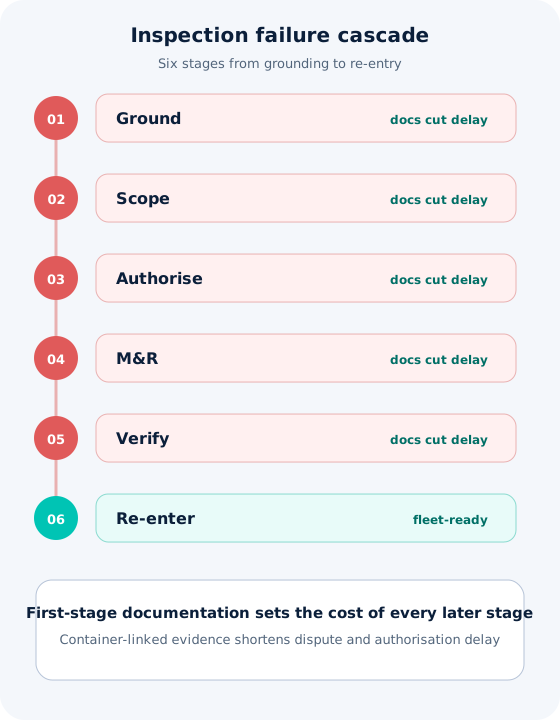
A single inspection failure sets off a predictable cascade — six operational stages, each consuming time, labour, and depot capacity before the container moves again. At 928 million TEU handled globally in 2024, even a fraction of a percent translates to tens of thousands of containers trapped in this cycle.
Source: WSC / IMO Cargo Inspection Report 2024 · Drewry Global Container Terminal Operators Annual Review and Forecast 2025/26
What Happens After a Container Fails Inspection — and What Does It Cost?
When a container does not meet the structural, mechanical, or safety standards required for continued service, it enters a documented failure state. This is not a single administrative event — it activates a multi-stage operational sequence spanning grounding, damage scoping, repair, and re-verification. Each stage carries direct costs, and without structured documentation, each stage also creates dispute exposure that compounds over time.
ConPDS provides a structured photo documentation layer that can require configured views, link records to the validated container number, retain the capture timestamp, and keep records searchable within the configured retention period. This gives teams a central record to review when a failure triggers a dispute, repair claim, or re-inspection.
The Scale of the Problem: Global Container Inspection Volume
Container throughput reached record levels in 2024. Every port, every terminal, and every depot in this network processes containers that must pass inspection before loading. When defects are missed, the consequences cascade through the entire supply chain.
51.5MTEU · 2024ShanghaiWorld's busiest port
19.9MTEU · 2024LA + Long BeachNorth America's busiest complex
13.8MTEU · 2024RotterdamEurope's largest port
7.8MTEU · 2024HamburgCentral Europe's gateway
11.39% of inspected cargo shipments contained deficiencies in 2024 — up from 11% in 2023 and the highest rate in the inspection data series dating back to 2011. The most common issues: undeclared dangerous goods, incorrect documentation, and unsafe packing practices. Source: World Shipping Council / IMO GISIS, 2025.
928 million TEU were handled globally in 2024, a 7.2% increase year-on-year (Drewry, September 2025). The 11.39% figure measures cargo shipment inspection deficiencies — packing, declaration, and documentation — not the container structural fail rate, and ConPDS does not extrapolate it into a global container count. Applied only as an illustration against 928 million TEU, even a small fraction of a percent implies a large number of affected movements each year. Each deficiency, whether in the cargo or in the box itself, is a potential chain reaction waiting to begin.
The Inspection Failure Cascade: From Grounding to Rework in Six Stages
Every failed inspection follows a predictable operational path. Each stage consumes resources and creates dispute exposure. The quality of documentation at the very first stage determines how efficiently — or how expensively — every subsequent stage unfolds.
Structured, container-linked documentation shortens delay at every stage of the cascade.
01
Taken Off the Grid
The unit is pulled from the operational fleet. It cannot be loaded, cannot be repositioned, and cannot fulfil its next booking. Every hour it occupies yard space is an hour of idle capacity — and a ripple that reaches the shipper waiting for equipment.
Fleet availability reducedYard space occupiedBooking fulfilment at risk
02
Damage Scoping and Accountability
Before any repair is authorised, the defect must be classified, the responsible party identified, and the cost allocation agreed. Without structured, timestamped photo evidence linked to the container, this stage becomes a protracted back-and-forth between depot, carrier, and asset owner.
Liability unclearEvidence retrieval delays
03
Repair Authorisation — Where Cost Is Won or Lost
Not every defect requires the same intervention. Overspecifying the repair wastes budget. Underspecifying it creates a recurrence. Choosing the wrong technique means the defect returns — and the cycle restarts. Detailed photo evidence of the defect type and severity is what enables the correct call.
Budget overrun if overspecifiedRecurrence if underspecifiedWrong technique = restart
04
M&R Execution
Labour hours, raw materials, welding bays, and workshop scheduling — all consumed for a unit that a thorough initial inspection could have flagged earlier or scoped correctly from the outset. During this stage the container generates cost without generating revenue.
Workshop slot occupiedLabour & material spend
05
Post-Repair Verification
Before the container can re-enter the fleet, it must pass a second inspection — confirming the repair meets the required standard. One failure now means two full inspection cycles. Without a structured system, the verification record is often disconnected from the original failure documentation.
Two inspections for one unitTraceability gap risk
06
Fleet Re-Entry
Only when every preceding stage is complete and verified does the container become available again. The cascade is over — but the accumulated cost across five preceding stages has already been absorbed. A complete, container-linked documentation trail is typically what supports recovering those costs through M&R claims and dispute resolution.
Verified & fleet-readyFull documentation trail
Why the First Inspection Determines the Total Cost of Failure
At every stage of the cascade, the same question surfaces: was the original defect documented accurately, and can that documentation be retrieved? Structured, container-linked evidence gives reviewers a stronger basis for resolving the incident before uncertainty compounds.
timer
Time Multiplier
One failure triggers two inspections — and the repair, liability, and re-inspection stages can each take days if documentation is incomplete or dispersed.
payments
Cost Multiplier
Unresolved disputes, incorrect repair scoping, and delayed container return can create absorbed costs. Structured evidence can help prevent avoidable losses and support recovery where the contract and full record justify it.
balance
Dispute Multiplier
Without photos linked to a validated container number and a retained capture timestamp, the Stage 2 liability review has less reliable context. Device-recorded location can add context when enabled and available, but it is not independent proof of presence.
How Structured Documentation Shortens the Cascade at Every Stage
ConPDS does not prevent container defects. It helps teams document and retrieve each configured stage of the response, supporting faster review and better-founded cost-recovery decisions.
photo_camera
OCR at Capture
Checker reads the container number on the device at the moment of inspection and checks it against the ISO 6346 check digit; if recognition is wrong, the user can retake the photo or type the number manually.
lock
Preserved Metadata
The capture timestamp is retained, and device-recorded location can be included when enabled and available as context. Uploads use encrypted transport; later edits are tracked and the original is retained for restore.
link
ISO 6346 Validation
Every container number is checked against the ISO 6346 check digit before the record is accepted — reducing association errors at source.
folder_open
Instant Retrieval
Full container photo history retrieved by container number in seconds — not hours searching WhatsApp threads and shared folders.
language
Secure Guest Portal
Share container-linked evidence with shipping lines, leasing companies, and insurers through a controlled, logged distribution channel.
checklist
Full Audit Trail
Every inspection, distribution, and access event logged — demonstrating who documented what, when, and who received it.
Frequently Asked Questions
How does structured documentation reduce the cost of a failed inspection? ▲
Linking photos to a validated container number with a retained capture timestamp gives the Stage 2 liability review a stronger factual basis. Device-recorded location can add context when enabled and available, but it is not independent proof of presence. Accurate defect documentation can also support better-informed repair decisions at Stage 3.
Does ConPDS replace our Depot Management System? ▲
No. ConPDS integrates with existing Depot Management Systems via REST API, FTP, and SFTP — adding the structured photo evidence layer that most DMS platforms do not natively provide. It works alongside your current systems, not in place of them.
Does the inspection app work offline in depot yards? ▲
Yes. The ConPDS Checker mobile app works fully offline: OCR reads the container number on the device and checks it against the ISO 6346 check digit; if recognition is wrong, the user can retake the photo or type the number manually. Photos are stored encrypted on the device and sync automatically once connectivity is restored. All core inspection functions operate without an internet connection.
How does re-inspection documentation link to the original failure record? ▲
Because every photo is linked to the container number via ISO 6346 check-digit validation, the post-repair verification record (Stage 5) is automatically associated with the original failure documentation. The full sequence — initial defect, repair authorisation, and re-inspection — is retrievable as a single container history.
Can the evidence be exported for M&R claim processing? ▲
Yes. Any container's full photo history — including before-and-after repair documentation — can be retrieved by container number and shared via secure guest portal, email, FTP, or API. Every distribution event is logged in the audit trail with a timestamp and recipient record.
How Container Depots Should Structure Inspection Photo Workflows
A structured, sequenced approach to capture-through-retrieval — the operational pattern that keeps a single failed inspection from turning into a six-stage scramble.
Every Failed Inspection Is Six Problems in Sequence
The question at the centre of all of them is the same: how accurate and how retrievable was the documentation from the first inspection?
What Happens Without Structured Container Inspection Documentation
✗Grounding costs absorbed: The container sits idle while depot staff search chat threads and shared folders for evidence that may no longer exist.
✗Disputes harder to resolve: Without timestamped, container-linked photos, the Stage 2 liability question has less reliable evidence and can take longer to review.
✗Repairs incorrectly scoped: Without detailed defect documentation, the repair decision at Stage 3 is based on memory and verbal reports — leading to over-repair, under-repair, or repeated failure.
✗Re-inspection disconnected: The re-inspection record exists in a different system, folder, or device — with no link to the original failure report.
✗M&R claims rejected: Repair claims submitted without structured before-and-after evidence tied to a validated container number are routinely challenged — increasing claim cycle time and reducing recovery rates.