How to Document Container Stuffing for Cargo Damage Claims
Most cargo damage claims fail or succeed on a single question: what condition was the container and the cargo in at the moment of loading? A structured container stuffing evidence system answers that question with timestamped, container-linked photos — pre-stuffing, during-stuffing, seal closure, and arrival condition all filed under one validated container number.
Trusted by container depots, freight forwarders, and shipping lines across Europe, Africa, Australia and the Middle East — from single-site loaders to enterprise stuffing operations documenting tens of thousands of movements monthly.
No credit card required · Standard onboarding in a few hours · Privacy-by-design
A container stuffing evidence system is a structured platform that captures photo evidence of the container loading process — from pre-stuffing interior inspection, through cargo placement and lashing, to seal number capture at door closure — and links every image to a validated ISO 6346 container number. A booking reference can be stored in notes or tags on the case. Its purpose is evidentiary: to create a retrievable, timestamped record of container and cargo condition at the moment of loading, so that cargo damage claims raised days, weeks, or months later can be reviewed against a documented baseline rather than reconstructed from memory.
ConPDS is the structured implementation of this category. The ConPDS Checker mobile app uses on-device OCR with ISO 6346 check-digit verification at capture — wrong recognition is flagged for retake or manual entry — and links every stuffing, packing, and loading photo to the correct container record. Booking references and other shipment identifiers can be stored in notes or tags. Pre-stuffing, during-stuffing, seal closure, and later unstuffing photos are archived under a single container history — giving loaders, freight forwarders, and shipping lines a structured evidence foundation for cargo damage claim review. Exact requirements follow the contract. For the wider principles behind this approach, the foundational guide to container operational evidence explains the category in full.
Container stuffing documentation covers:
Pre-stuffing interior inspection — empty container condition before any cargo enters
During-stuffing photos of cargo placement, stacking, and lashing
Optional freeform photos for flat-rack and out-of-gauge cargo — restraint, overhang, and tarpaulin — under the same case
Seal number photo capture at door closure, linked to the container record
Arrival-side unstuffing or devanning photos filed under the same container number as the loading record
Note: ConPDS is not a load calculator or stuffing optimisation tool. The search landscape for "container stuffing" is dominated by load-planning platforms — ConPDS occupies a distinct, evidence-focused position. It documents what was actually loaded, in what condition, and how it was secured. It does not model weight distribution or suggest stacking patterns.
Why Unstructured Loading Evidence Cannot Support Cargo Damage Claims
A freight forwarder or depot handling 40 stuffing events per day generates 400+ loading images daily across pre-stuffing, during-stuffing, and seal photos. Without container-level linking and a validated loading record, those images cannot be retrieved when a claim arrives — and a cargo damage dispute with no evidentiary baseline almost always defaults against the party that cannot produce records.
Documentation Gaps in Manual Loading Workflows
Stuffing photos captured on personal phones and sent via WhatsApp threads, email attachments, and shared folders — with no container-number linking
No record of pre-stuffing container condition — the loader cannot prove the container interior was clean and undamaged before cargo went in
Seal numbers photographed but not linked to the container record — images are retained but not retrievable when a claim is raised
Flat-rack and OOG cargo under-documented — lashing and restraint evidence often missing entirely
Consequences When a Cargo Damage Claim Is Raised
Cannot demonstrate the point at which damage occurred — pre-loading, during stuffing, or in transit — leaving the loader exposed by default
Arrival condition at unstuffing cannot be compared against loading condition because the two records live in different systems, if they exist at all
Claims for concealed damage are especially difficult to dispute without time-stamped, container-linked photo evidence of the stuffing sequence
Commercial settlements paid even on weak claims because the defensive evidence cannot be produced within the response window
Operational metric: A stuffing operation handling 60 containers per day generates 600+ loading images daily between pre-stuffing, during-stuffing, and seal documentation. Across a typical claim window of 30–60 days, that amounts to 18,000–36,000 images. Without a structured loading-evidence layer linking each image to a validated container number, retrieval under claim pressure is statistically unworkable.
Without Structured Stuffing Documentation
A claim arrives three weeks after arrival alleging concealed damage to the cargo. The loader has stuffing photos scattered across WhatsApp threads, email attachments, and shared folders — with no container number linkage and no guaranteed pre-stuffing baseline. By the response deadline, the complete photo set cannot be assembled or proven to belong to the container in question. The claim is paid.
With Structured Stuffing Documentation
The same claim arrives. The structured loading archive retrieves the full stuffing history by container number in seconds: pre-stuffing interior, cargo placement, lashing, seal closure photo — all linked to the validated ISO 6346 number and timestamps. The record shows cargo and container condition at load; arrival photos under the same container number support review of where damage is more consistent — without guaranteeing claim outcomes.
How Container Loading Documentation Works Step by Step
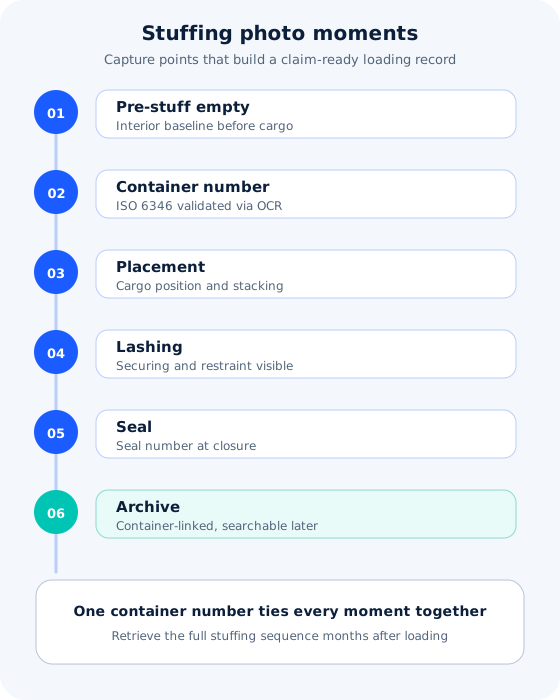
Six recommended workflow steps convert a stuffing event into a container-linked photo record that can be retrieved months later. Checker guides structured capture; it does not enforce required photo sequences. ISO 6346 validation still applies when a container number is captured via OCR.
Six capture moments turn a loading event into a container-linked record that can be retrieved months later.
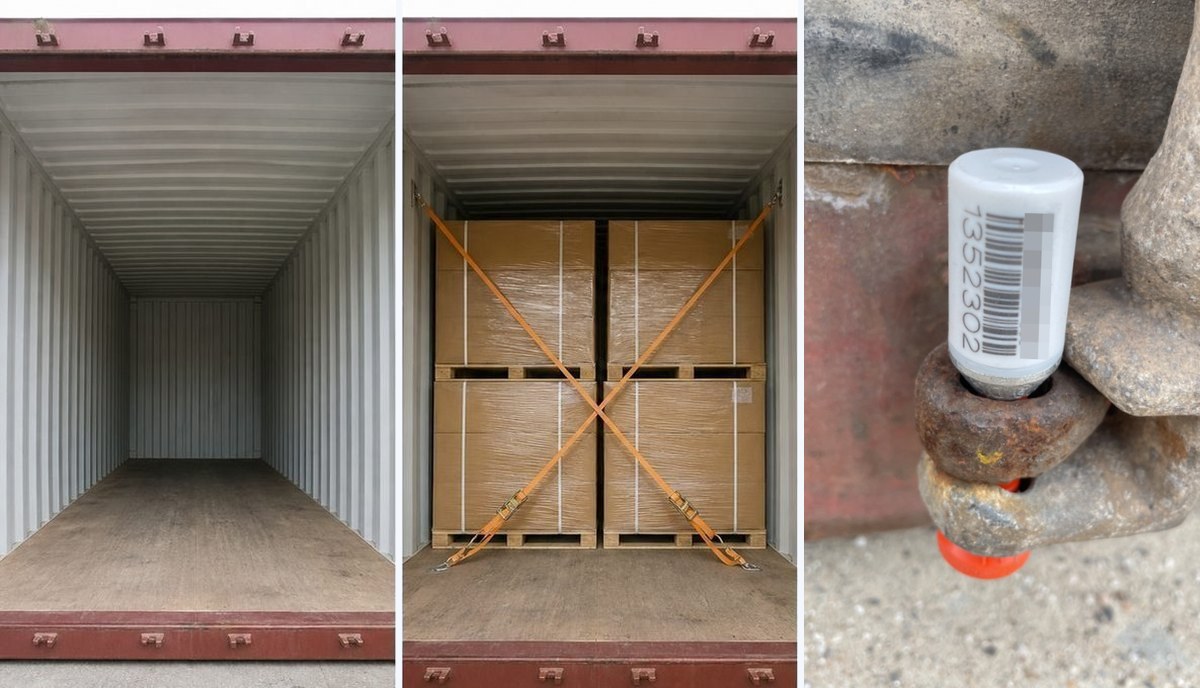
Physical capture sequence
Empty interiorPlacement and lashingSeal at closure
Illustrative stuffing moments — empty baseline, secured cargo, and seal condition — that belong under one container number.
STEP 01–02
Establish the Pre-Stuffing Baseline
Before a single item of cargo enters the container, the Checker app can capture the empty interior — floor, walls, roof, and door seals — and validates the container number against ISO 6346. A booking reference can be stored in notes or tags. This pre-stuffing baseline is the most commonly missing element in manual workflows and often the most useful element in a cargo damage dispute.
STEP 03–04
Capture Placement, Lashing, and Seal
During the loading event, the app can capture recommended photos covering cargo position, stacking, and lashing. For flat-rack and out-of-gauge cargo, add freeform photos of restraint hardware and tarpaulin coverage under the same case — there is no separate OOG mode. At door closure, the seal number can be photographed and optionally barcode-scanned; the scan is linked to the relevant photo or case. The physical seal photo documents intact, tamper-evident seal condition at door closure.
STEP 05–06
Archive, Distribute, and Match at Unstuffing
The full stuffing set is archived under the validated container number. When distribution rules are configured, photos can be sent via email, FTP, SFTP, or API — immediately or after a delay — with every attempt logged. At the destination, devanning photos can be filed under the same container number for side-by-side review. For the wider dispute-resolution context in which this evidence is used, the guide on how to reduce inspection disputes covers the operational patterns in detail.
Photo Sequences Specific to Stuffing, Packing, and Unstuffing Operations
Container loading evidence is not a single photograph — it is a recommended sequence of container-linked images that together form a usable loading record. The detail below is editorial guidance for what to capture at each stage, across standard dry containers, flat-racks, and OOG units, and on the devanning side at arrival — not an enforced product mode.
photo_camera
Pre-Stuffing Interior & Exterior
Empty interior — floor, walls, roof, door seals — photographed before any cargo enters. Exterior condition and container identification markings captured in the same sequence. Establishes the baseline that cargo ownership transferred into a sound container.
inventory_2
Cargo Placement & Stacking
Cargo position, stacking pattern, and dunnage captured at the point each unit load is placed. For packing operations with cartons, drums, or palletised goods, the sequence records how cargo is arranged before lashing and restraint are applied.
link
Lashing & Restraint
Photos of all restraint hardware — straps, chains, airbags, blocking — captured before doors are closed. Proves the load was secured to the standard required by the shipping line and the cargo contract, not simply loaded into an unrestrained container.
construction
Flat-Rack & OOG Coverage
Out-of-gauge cargo on flat-racks and open-tops often warrants extra freeform photos under the same case: lashing points, overhang dimensions, corner-casting integrity, and tarpaulin or shrink-wrap coverage. OOG cargo often carries higher claim values — denser documentation helps, but Checker does not enforce a separate OOG sequence.
lock
Seal Number at Door Closure
The seal can be photographed on closure, with the number legible, and linked to the same container record. Optionally scan the seal barcode — the scan is linked to the relevant photo or case. The physical seal photo documents intact, tamper-evident seal condition at door closure.
inbox
Unstuffing / Devanning / Stripping
At destination, the recommended devanning set covers seal condition on arrival, door opening, initial cargo visibility, cargo condition as it comes out, and empty interior at completion. Filing those photos under the same container number lets teams compare load and arrival condition — without automatic seal-continuity matching.
Manual Loading Workflows vs. Structured Stuffing Documentation
Loading evidence requirement
Manual methods (WhatsApp, email, shared folders)
ConPDS — structured stuffing evidence platform
Pre-stuffing baseline
Rarely captured — no proof the container was clean and undamaged before loading
Guided pre-stuffing capture under the same case before during-stuffing photos are added
Container-number linking
Filenames, memory, or none at all — retrieval fails at volume
On-device OCR with ISO 6346 check-digit verification; wrong recognition flagged for retake or manual entry; every image linked to the validated container number
Seal number capture
Often photographed but orphaned — not linked to the container record
Seal photo (and optional barcode scan) linked to the photo or case; documents intact, tamper-evident physical seal at door closure
Flat-rack / OOG coverage
Inconsistent — the highest-value cargo is often the least documented
Freeform photos under the same case for lashing, overhangs, and tarpaulin — no separate OOG mode
Distribution record
No log — unable to prove what was sent, to whom, or on which date
Every distribution event logged: recipient, date, channel, and document set — retrievable at any time
Paired loading & unloading evidence
Stuffing and devanning photos live in different systems, if they exist at all
Arrival devanning photos filed under the same container number as the stuffing archive
Operational Benefits of Structured Container Packing Photo Documentation
The value of structured stuffing evidence reaches beyond claim defence. Structured loading evidence reduces administrative friction with carriers and insurers, accelerates external distribution, and creates a retrievable cargo-handling archive that scales with volume.
shield
Cargo Damage Claim Defence
A complete, timestamped, container-linked stuffing record shifts the evidentiary weight in a claim dispute. The loader is no longer defending against a claim with fragmented records — they are answering it with a verifiable baseline.
search
Instant Retrieval by Container Number
Any loading record is accessible by container number from the web dashboard in seconds (notes and tags remain searchable too). No reconstructing sequences from personal devices — even months after the original stuffing event.
send
Rule-Based Distribution to Carriers & Insurers
Configure which stuffing documentation goes to which shipping line, forwarder, or insurer via email, FTP, SFTP, or API. Rules can trigger immediately or after a delay; every attempt is logged with success or failure for manual retry when needed.
compare_arrows
Pre-Loading vs. Transit Damage Separation
Pre-stuffing photos isolate the question of whether damage was present before cargo was loaded. Unstuffing photos isolate arrival condition. The pair answers the transit-versus-loading question that cargo damage claims are built on.
straighten
Flat-Rack and OOG Evidence Coverage
Higher-value claims often involve out-of-gauge cargo. Freeform photos under the same case for flat-rack, open-top, and OOG movements — lashing points, overhangs, tarpaulin — help match the documentation density these movements often need.
cable
Integration Without System Replacement
ConPDS connects to loader, forwarder, and depot systems via REST API, FTP, or SFTP — adding the structured photo evidence layer without replacing any operational software. Stuffing documentation flows into existing systems without parallel entry.
Evidence Integrity, Data Governance, and Seal Number Documentation
Loading photos on their own are rarely enough for claim review. What strengthens a stuffing image into a usable record is the surrounding architecture — validated container identity, preserved capture metadata, controlled access, and a continuous audit trail that shows who saw and received what. A structured loading-evidence platform supports all four at the moment of capture.
privacy-by-design data architecture256-bit HTTPS encryption on-device and in transitISO 6346 container number validation at captureBooking reference via notes or tags on the caseRole-based access controls across loader and forwarder teamsConfigurable data retention periodsCapture timestamp and device-recorded GPS when availableContinuous audit trail of access, share, and distribution events
Capture metadata retained: Each stuffing photo carries its capture timestamp and can include device-recorded location when enabled and available as context for review, not independent proof of presence.
Container-linked continuous audit trail: The full history of a container's loading record — who captured what, when it was distributed, and which parties accessed it — is retrievable in the continuous audit trail (including later edits with original retained, tags, and notes). For the technical foundations of how audit trail architecture supports container inspection and loading evidence, see the audit trail guide for container inspections.
On-device storage until upload: Stuffing photos are stored encrypted on the device until upload; a local copy is retained for about seven days after successful upload. The authoritative archive lives in the EU-hosted cloud tenant — not in WhatsApp threads or personal camera rolls.
It captures and archives photo evidence of the loading process — pre-stuffing container condition, cargo placement and lashing, seal number at closure — and links every image to a validated ISO 6346 container number. A booking reference can be stored in notes or tags on the case. It provides a structured evidence basis for cargo damage claim review by documenting container and cargo condition at the moment of loading.
Is this a load planning or cargo optimisation tool? ▲
No. ConPDS is not a load calculator or stuffing optimisation platform. It does not model weight distribution or stacking geometry. It is a structured photo evidence system that documents what was actually loaded, how it was secured, and in what condition — supporting cargo damage claim review, not load-plan outputs.
Does the mobile app work offline during loading operations? ▲
Yes. The ConPDS Checker mobile app is fully offline-capable — on-device OCR with ISO 6346 check-digit verification reads container numbers (wrong recognition flagged for retake or manual entry), and photos are stored securely on-device, syncing automatically once connectivity is restored. Loading sites and warehouse docks without stable connectivity can document every stuffing event without interruption.
Is stuffing documentation data secure and privacy-by-design? ▲
Yes. All photos are encrypted on-device and during upload using 256-bit HTTPS. Role-based access controls, configurable retention periods, and a continuous audit trail of every access and distribution event support GDPR-governed workflows throughout the documentation lifecycle. Photos are stored encrypted on the device until upload; a local copy is retained for about seven days after successful upload.
Can stuffing documentation be used for cargo damage claims against the carrier? ▲
A structured pre-stuffing and during-stuffing photo record — with validated container number, optional booking reference in notes or tags, timestamp, and device-recorded GPS when available — can establish a narrative of cargo and container condition at loading. When damage is discovered on arrival, that gate-in / gate-out style baseline helps parties assess whether damage is more consistent with pre-loading, stuffing, or transit. Exact evidentiary requirements and legal sufficiency follow the contract and applicable rules — ConPDS does not claim universal admissibility.
Does ConPDS cover flat-rack and out-of-gauge (OOG) cargo documentation? ▲
Yes. Flat-rack and out-of-gauge (OOG) cargo can be documented under the same case as any other stuffing event. Field staff can add freeform photos of lashing points, load restraint, overhangs, and tarpaulin coverage — there is no separate OOG or flat-rack mode. Each photo is linked to the validated container number and retained with the loading record.
Can unstuffing and arrival condition evidence be linked to the original stuffing record? ▲
Yes. Devanning photos captured at destination can be filed under the same container number as the original stuffing record — producing a paired loading and unloading archive. Comparing timestamped stuffing photos against timestamped stripping photos supports a clearer narrative of where damage is more consistent — without automatic seal-continuity matching across load and devan, and without substituting for contractual or legal determination.
Related Resources
Explore the platform pages and authority guides that support container stuffing, unstuffing, and cargo damage documentation across loading operations.
Make Every Loading Event a Structured Photo Record
Cargo damage claims resolve on records, not explanations. Structured loading evidence gives loaders, forwarders, and shipping lines a container-linked evidence archive covering every stuffing, packing, and unstuffing event — without replacing the operational software already in place.
Without structured container stuffing documentation
✗Unwinnable cargo damage claims: No provable pre-stuffing baseline — the loader cannot demonstrate whether damage occurred before loading, during stuffing, or in transit.
✗Orphaned seal photos: Seal number images captured but not linked to the container record — evidence that exists but cannot be retrieved when the claim arrives.
✗Missing OOG and flat-rack evidence: The highest-value movements documented the least — lashing and restraint photos absent from the records that matter most.
✗Scattered loading and unloading records: Stuffing photos in one system, devanning photos in another — no shared container-number archive for comparing load and arrival condition.
✗Default settlements on weak claims: Defensive records cannot be produced within the claim response window — commercial settlements paid to avoid escalation, regardless of claim merit.
No credit card required · Standard onboarding in a few hours · Privacy-by-design