The invoice arrived eleven weeks after you returned the container — €840 for panel repair you do not recognise. You are not alone: repair bills land months late, liability is unclear, and the dispute window is already counting down. Here is what to do, in order.
A container damage invoice is a bill for maintenance and repair work performed on a shipping container after you returned it — issued by a shipping line, leasing company, or their depot partner. Line items cover structural repairs, door and panel damage, floor work, and cleaning beyond fair wear. The invoice assumes damage occurred during your custody unless you produce evidence showing the condition was pre-existing or that someone else held the unit when the damage happened.
Contesting the invoice means submitting photographic and documentary evidence that contradicts the billed damage assessment — typically a matched pickup-and-return photo pair with the container number visible, linked to ISO 6346 validation and preserved capture metadata. ConPDS Checker is the structured implementation: mobile capture and an email dropbox that files third-party photos automatically, producing a container-indexed archive you search when the bill arrives — not a scramble through camera rolls three months later.
Why Does the Repair Bill Arrive Months After Return?
Depot M&R queues, shipping line billing cycles, and batch invoice runs mean illustrative windows of about 30–90 days between return and invoice are common — check your contract for the actual timing. A TCompanies survey of the US intermodal fleet (reported by FreightWaves) estimates roughly 25% of containers and trailers in circulation carry damage. By the time the bill lands, the driver who took pickup photos may have changed phones and the WhatsApp thread may be gone. A conservative illustration of the chase that follows: about 30–60 minutes on the billed party’s side and about 20–40 minutes on the reviewing side — roughly one to one-and-a-half hours of organisational time — before a dispute package is even well formed.
Operational detail: Deposit hold periods often overlap the billing delay — your port deposit (typically around €1,000 per dry box, €2,500+ on the most contested lanes) may still be encumbered when the repair charge is applied, giving you one shot to attach evidence before the deduction becomes final. Missing that window because photos are unfindable is the most common preventable loss in container repair disputes.
✗ Without retrievable evidence
Invoice arrives on a Tuesday. Claims clerk spends the better part of an hour searching email, calls two drivers, finds partial photos without the container number in frame. Dispute submitted late with weak attachments. Charge upheld.
✓ With structured evidence on file
Same invoice. Clerk searches container number in ConPDS, exports pickup-and-return set in 45 seconds, attaches to dispute letter. Pre-existing dent visible at pickup. Charge reduced by €640 same week.
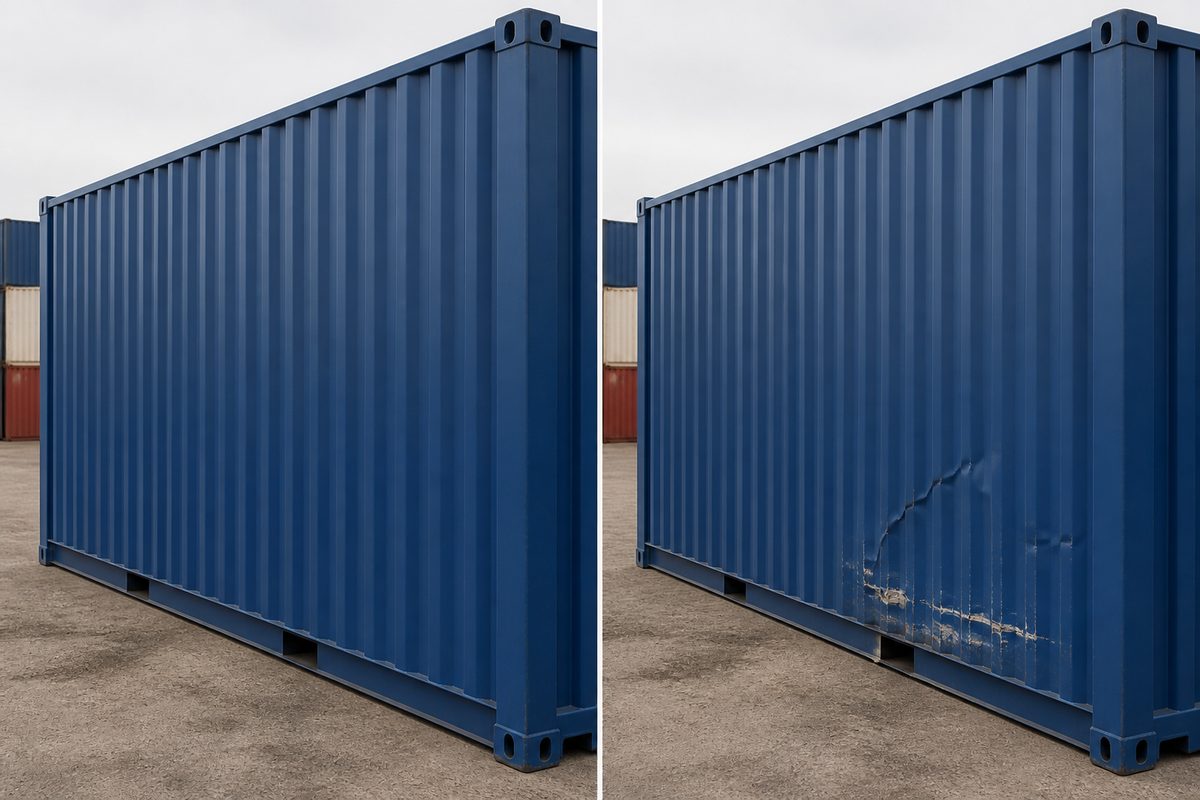
Illustrative matched pair
Pickup vs return on the same face — the matched pair that dispute desks ask for when an invoice arrives months later.
Structured retrieval
When photos are filed under the container number, retrieval is a search — not a chase across phones and inboxes.
Who Pays for Container Damage — and How Is Liability Assigned?
The invoice names you, but custody may have transferred several times. A party without handover photos has less evidence to show the container's prior condition; liability still depends on the contract, counterparty process, and full record.
Loader / shipper
Stuffing and cargo-handling damage
Damage inside the container from loading, lashing, or incompatible cargo. Dispute basis: exterior photos at empty return showing damage pattern inconsistent with transit handling.
Trucker / haulier
Road transit and gate handover
Dents, door misalignment, and chassis-related damage during drayage. Dispute basis: pickup photos from depot showing condition before your custody began.
Terminal
Yard storage and crane handling
Damage during port or inland terminal stay. Dispute basis: gate-in vs gate-out photo comparison if you hold terminal custody records.
Line / lessor / depot
Post-return assessment
The party that issued the invoice. Their depot documents return condition — your independent record is the counter-evidence. For how operators structure that side, see container repair claim defence evidence.
Understanding what container operational evidence is — a defensible, container-linked record produced on demand — frames why informal photos fail and structured archives win when liability is contested.
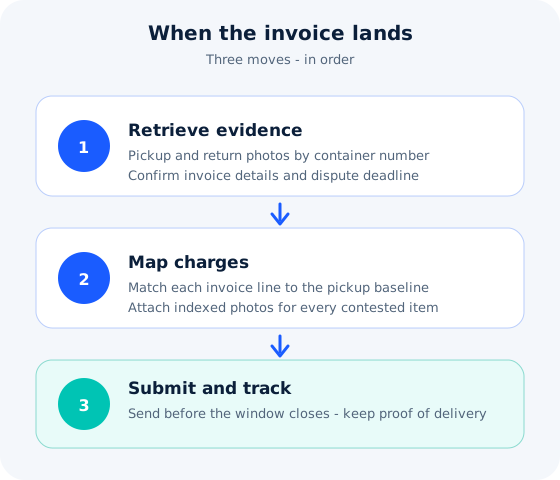
What Should You Do When the Invoice Lands?
Six steps — in order — from receipt through follow-up. Do not skip evidence retrieval; everything downstream depends on it.
Retrieve first, map each charge to photos, then submit before the dispute window closes.
01
Verify invoice
Container number, dates, dispute deadline
02
Retrieve photos
Pickup and return by container number
03
Compare damage
Invoice line items vs pickup baseline
04
Prepare dispute
Letter + photo package per contested item
05
Submit on time
Billing party portal or email — keep proof
06
Follow up
Escalate if unresolved past review period
STEP 01–02
Verify the Invoice and Retrieve Your Photo Record Immediately
Confirm the container number and return date match your records. Note the dispute deadline — missing it forfeits the formal process even when evidence is strong. Retrieve pickup and return photos before calling anyone: if they live in a structured archive, search by container number; if not, contact drivers and search devices today, not next week.
STEP 03–04
Map Each Charge to Your Pickup Baseline and Draft the Dispute
For every line item, ask: was this visible at pickup? Attach the specific photo. State clearly which charges are contested and which you accept. A one-page letter with indexed photo attachments outperforms a long narrative without visuals.
STEP 05–06
Submit Before the Deadline and Track the Response
Send to the contact on the invoice. Keep read receipts. If the operator's review period passes without resolution, follow up in writing and involve your forwarder or lessor. Deposits still on hold may be released partially when evidence is accepted.
What Photos Do You Need to Win the Dispute?
Operators and freight forwarders consistently cite the same minimum: before-and-after photos with the container number visible. Everything else strengthens the record but this is the floor.
Pickup: all six exterior sides, doors open (floor and door seals), roof if safely accessible, close-ups of any pre-existing damage
Return: same angles at hand-back — the matched pair shows what changed during your custody
Container number in frame: ISO 6346-validated — owner code, serial number, and check digit readable on the marking plate or door
Capture context: Checker retains the timestamp and can include device-recorded location when enabled and available; normal chat or email forwarding does not reliably preserve original capture metadata
How Do You Capture Evidence Before the Next Invoice?
The advice every freight forwarder blog ends with — take before/after photos with the container number visible — is correct. The gap is storage and retrieval. ConPDS Checker closes it.
photo_camera
Mobile capture
Field staff photograph condition in the Checker app — container number read and validated by OCR at capture, offline-capable at remote yards.
mail
Email dropbox
Hauliers and subcontractors email photos in — no app install. Platform files images against the correct container record automatically.
search
Retrieval when invoiced
Search container number → export matched pickup-and-return set → attach to dispute letter. Seconds, not hours.
Quantify what a lost dispute costs against your fleet — the shipper ROI calculator models repair-charge incidence and deposit exposure. Runs locally; no data sent to ConPDS.
Frequently Asked Questions About Contesting Damage Invoices
How long do I have to dispute a container repair charge?
▼
Dispute windows vary by shipping line, leasing company, and contract. A 14–30 day window is an illustration only, not an industry rule. Check the invoice, lease, equipment interchange agreement, or counterparty procedure for the applicable deadline and notify the billing party promptly.
What photos do I need to contest a damage invoice?
▼
Matched before-and-after set with container number visible — all sides, doors, floor, pre-existing damage close-ups. Timestamp and GPS metadata strengthen the submission.
Can I dispute a repair bill if I only have pickup photos?
▼
Often yes — if pickup photos show the billed damage was pre-existing at handover. Return photos strengthen the case; the matched pair is ideal.
Who should I send a container damage dispute to?
▼
The billing party on the invoice — line equipment desk, lessor M&R, or depot claims. Include container number, invoice reference, contested line items, and photo attachments.
Does an EIR replace photographic evidence in a dispute?
▼
No. EIR tick-boxes rarely capture full condition. Photos with the container number visible provide the visual baseline operators expect when damage is contested months later.
Can third-party hauliers contribute photos without installing software?
▼
Yes — ConPDS email dropbox files photos from any sender against the correct container record. App capture adds automatic OCR; both paths feed the same archive.
Stop Reconstructing Evidence Under Invoice Deadline Pressure
The next repair bill will arrive on its own schedule. The evidence either exists in a searchable archive or it does not — and that difference is usually worth more than the disputed line item.
What Happens When You Contest Without Structured Evidence
✗Dispute window expires during the search: Admin time spent finding photos counts against the contract- or counterparty-specific response deadline.
✗Submission lacks container number in frame: Operators reject attachments they cannot tie unambiguously to the unit.
✗Capture context becomes unreliable: Normal chat or email forwarding does not reliably preserve original capture metadata. Checker mobile capture retains the timestamp and can include device-recorded location when enabled and available; location is context, not independent proof of presence.
✗Pre-existing damage cannot be shown: Without pickup baseline, every dent on the invoice is assumed to be yours.
✗Deposit released minus full charge: Partial disputes fail when evidence supports only some line items but none were documented at pickup.