Which Inspection Workflow Bottlenecks Should a Depot Measure and Address First?
Most depots do not have one large documentation problem — they have several small, unmeasured ones: photos that take longer than they should to find, the same event captured twice, a container number typed wrong under time pressure, and a shipping line asking "did you actually send that?" months later. This guide sets out five bottlenecks worth measuring, and a self-audit method for finding out which one is costing your depot the most before you invest in fixing any of them.
Inspection workflows rarely fail all at once. They accumulate small frictions — a retrieval request that takes twenty minutes instead of two, a photo filed against the wrong container, a forwarded email nobody can confirm arrived — that individually look like one-off inconveniences. Staff absorb them without escalating, because each one, taken alone, is not worth a project. The cost only becomes visible when you add them up across a week, a shift pattern, or a claim season.
Retrieval requests are handled ad hoc, so nobody tracks how long they actually take
Duplicate captures and misassociated photos are invisible until a specific record is needed
Distribution to shipping lines and lessors is assumed to have worked unless someone complains
Without a measurement baseline, it is hard to know which fix would actually save the most time
Five Inspection Workflow Bottlenecks to Measure
Each of these shows up differently depending on the depot, but all five are measurable with a pen, a spreadsheet, and a sample period — no new tooling required to get a first reading.
search
Retrieval time
How long it takes from "we need the photos for container X" to the full, correct set being in front of the person who asked. Measure it by timing a sample of real requests, start to finish.
content_copy
Duplicate capture
The same inspection event photographed more than once — often because the first attempt was not confirmed as successful. Measure it by spot-checking a sample of recent records for repeat sets covering the same event.
error_outline
Container misassociation
A photo filed under the wrong container number, usually from manual typing or renaming under time pressure. Measure it by auditing a sample batch of records against the container numbers visible in the photos themselves.
gavel
Dispute lookup time
How long it takes to assemble a complete, defensible record — photos, timestamps, and distribution history — once a claim or dispute is raised. Measure it against a real recent dispute, or a simulated one if none is currently open.
forward_to_inbox
Distribution confirmation
Whether a depot can prove documentation actually reached the shipping line, lessor, or agent it was meant for. Measure it by checking whether a delivery record exists for a sample of recent dispatches.
What Unaddressed Bottlenecks Cost Operationally
None of these five bottlenecks is dramatic on its own. Compounded across a busy depot and a full claim cycle, they consume administrative time and weaken the depot's position exactly when evidence matters most.
What It Looks Like
schedule
A retrieval request turns into a search through folders, threads, and inboxes instead of a lookup
link_off
A claim review stalls because the photo on file is linked to the wrong unit
help_outline
A shipping line disputes receipt, and there is no record to settle the question quickly
Why It Compounds
people
Each bottleneck consumes administrative time that would otherwise go toward operational work
trending_up
Retrieval and association problems scale with inspection volume — more containers, more instances
balance
Weak evidence at dispute time shifts leverage to the counterparty raising the claim
A Five-Step Self-Audit for Finding Your Top Bottleneck
Before choosing what to fix, spend a sample period measuring what is actually happening. This does not require new software — a sample period, a spreadsheet, and a bit of discipline is enough for a first reading.
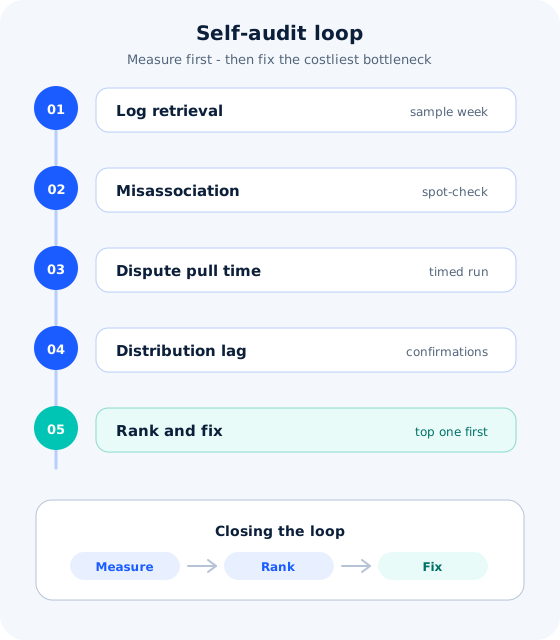
Measure the five bottlenecks, then close the loop: measure → rank → fix the highest-cost issue first.
Retrieval hunt
Unstructured photos live across inboxes, printouts, and devices — timing a dispute pull exposes the cost.
Container-linked archive
Structured capture turns the same pull into a container-number search with a complete photo set.
Step 01
Log Retrieval Requests for One Week
For a sample week, record every retrieval request — container number, time requested, and time the full photo set was actually located and sent. This turns a vague sense of "retrieval takes a while" into a measured range you can compare against.
Step 02
Sample a Batch of Records for Duplicate or Misassociated Photos
Pull a sample of recent inspection records and check whether each photo is filed under the correct container number, and whether the same event was captured more than once. A manual spot-check on 20–30 records is usually enough to surface a pattern.
Step 03
Time a Real or Simulated Dispute Evidence Pull
Take a recent disputed charge — or simulate one if none is currently open — and time how long it takes staff to assemble the full inspection record: every relevant photo, timestamp, and distribution log entry, from scratch.
Step 04
Check Distribution Confirmations for a Sample of Recent Dispatches
Review a sample of documentation that was supposed to reach a shipping line, lessor, or agent, and confirm whether a delivery record exists for each one. Gaps here surface as forwarding disputes later, when they are far more expensive to resolve.
Step 05
Rank the Bottlenecks by Time Cost and Address the Top One First
Compare the measured time cost of each bottleneck from steps 1–4, and address the highest-cost one first. Trying to fix retrieval, association, and distribution simultaneously usually means none of them gets fixed well.
Where a Structured Capture Platform Removes These Bottlenecks
Once a depot knows which bottleneck costs the most, ConPDS Checker addresses each of the five directly. Checker OCR reads the container number on the device, including offline, and verifies the ISO 6346 check digit before the photo is linked to the record — wrong recognition is flagged, and if a number is not recognized, the technician can retake the photo or type it in manually, which is what keeps misassociation from reaching the archive in the first place. Every capture, access, and distribution event is logged automatically — including photo edits (with the original retained for recovery), tags, notes, and later changes to those fields — so a dispute evidence pull is a search by container number rather than a reconstruction. Where a distribution rule is configured, documentation is dispatched via email, FTP, SFTP, or API, immediately or after a configured delay, with every attempt logged as success or failure — turning "did you send that?" into a lookup.
A standard Checker onboarding takes a few hours. After that the customer can capture photos, build the evidence record, search, review, and share them by email. Automated workflows, mailbox processing, and many external destinations can take some days. Neither timing is a contractual promise.
Related Resources
This guide is about which bottleneck to measure and fix first. For the full capture-to-retrieval sequence or the platform that implements it, continue here.
What counts as an inspection workflow bottleneck worth measuring? ▼
A bottleneck is any point where staff time is consumed re-doing, re-finding, or re-confirming work that should have been settled at the moment of capture. The five most common in depot inspection workflows are retrieval time, duplicate capture, container misassociation, dispute lookup time, and unconfirmed distribution.
How can a depot measure photo retrieval time without new software? ▼
Pick a sample week and ask whoever handles retrieval requests to note the container number, the request time, and the time the full photo set was actually found and sent. A handful of timed samples is usually enough to see whether retrieval is a five-minute task or a recurring half-hour search.
What is container misassociation and why does it matter? ▼
Misassociation is when an inspection photo is filed against the wrong container number — usually from manual typing, filename renaming, or folder mix-ups. It matters because the error is often invisible until someone needs that exact record for a claim, and by then the correct photos may be unrecoverable.
How does distribution become a bottleneck if photos are already captured? ▼
Capturing a photo is not the same as a shipping line or lessor confirming they received it. Without a distribution log, a depot has no fast way to prove documentation was sent when a counterparty claims otherwise — so staff spend time reconstructing forwarding history instead of pointing to a record.
How quickly can Checker be deployed once a depot has identified its bottlenecks? ▼
A standard Checker onboarding takes a few hours. After that the customer can capture photos, build the evidence record, search, review, and share them by email. Automated workflows, mailbox processing, and many external destinations can take some days. Neither timing is a contractual promise.
Measure First, Then Fix the Bottleneck That Costs the Most
The self-audit above takes a sample period, not a project. Once you know whether retrieval, duplicate capture, misassociation, dispute lookups, or distribution confirmation is costing your depot the most staff time, the structured workflow guide below shows how a container-linked sequence removes it.